The pilot plant basically consists of a fluidized bed reactor with a processing capacity of 15 kg/h, and can operate with continuous feeding of biomass and fluidizing agent.
In this facility, gasification experiments of WWTP sludge, compost, and RDF (combustible fraction of urban solid waste) have been carried out, studying the quantity and quality of the gas obtained, as well as the by-products of gasification. The plant has all the "on-line" monitoring systems for both the production of condensable volatiles (TAR) and the gas composition (including NH3).
Equipment
This laboratory (not fully arranged yet) is, for the moment being, equipped with the following devices:
- Gas Chromatograph (GC-MS/FID/S) for characterization of gaseous effluents coming from waste treatment processes [Agilent 7890A/5975C/8355S]
- Liquid Chromatograph (HLPC-UV/RI) for quantification of non-volatile soluble compounds [Waters 1515/2487/2414]
- Elemental Analyzer (CHNS) at micro (TrueSpec) y macro (CHNS628) scale [LECO]
- Total Organic Carbon (TOC) for determination of organic carbon in aqueous streams [Shimadzu TOC-L]
- Thermogravimetric Analyzer (TGA+DTA+DSC) for thermal characterization of samples subjected to reactive atmospheres [Netzch STA Jupiter F1]
- Infrared Spectroscopy (FTIR) para for determination of functional groups in solid, liquid and gas samples [Agilent Cary 670] complemented with visible/IR microscopy for solids [610 FTIR]
- Calorimeter for determination of higher heating value of solid samples [IKA C-2000]
- Surface physi- and chemisorption analysis for solid simples [Quantachrome Autosorb iQ3 TPX]
The lab also includes an Inductive Coupling Plasma with Mass Spectrometer in tandem (ICP-MS/MS) that enables to determine and quantify elements and their isotopes at trace and ultratrace level. Its main use is serving as an analysis instrument in the field of environmental studies, Gas Chromatograph coupled with Mass Spectrometer with simultaneous detection of N and P (GC-MS). Aside from a conventional GS-MS, this device is equipped with an NPD detector. This issue serves in the studies devoted to the new generation of nitrogenous fertilizers with limited contribution of organic nitrogen and phosphorus. Finally a High capacity, high pressure mercury porosimeter (Hg-Porosim) can be used to operate at high pressures (400 MPa) and determine pores in the range of 3 nm for the analysis of samples of catalysts as well as solid wastes and their derivatives like those coming from biomass pyrolysis and gasification of wastes.
Complementary, thermal and rheological characterization is offered by a Laser Flash device (NTEZSH) for thermal diffusivity determination, that coupled with a Thermomechanical Analizer (Metler Toledo), a densimeter (Metler Toledo) and a DSC (NTEZSH) can determine the thermal conductivity of solid and liquid samples. Finally rheological characterization includes a Rheometer (TA Instrumetns) [Torque resolution 0.1 nN·m; Displacement resolution 2.5·10-8 rad]
Scientific and technical services offered
DSC (Differential Scanning Calorimeter)
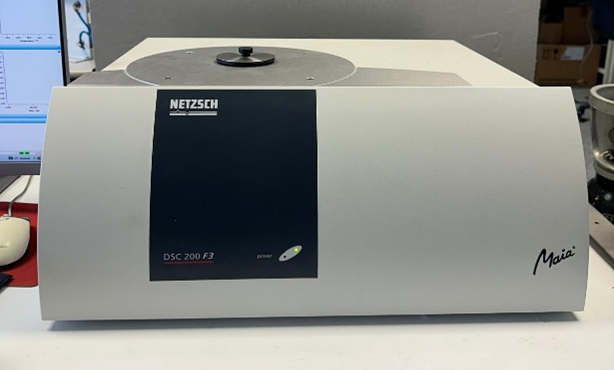
Model: DSC 200 F3 Maia, Netzsch
Properties: Phase transition temperature, glass transition temperature, specific heat, enthalpy of phase transition
Temperature range: -100ºC / 600ºC
Samples: solid / liquid
Sample size: 20 mg
Contact:
- Mónica Delgado: monica@unizar.es
Laser Flash (LFA)
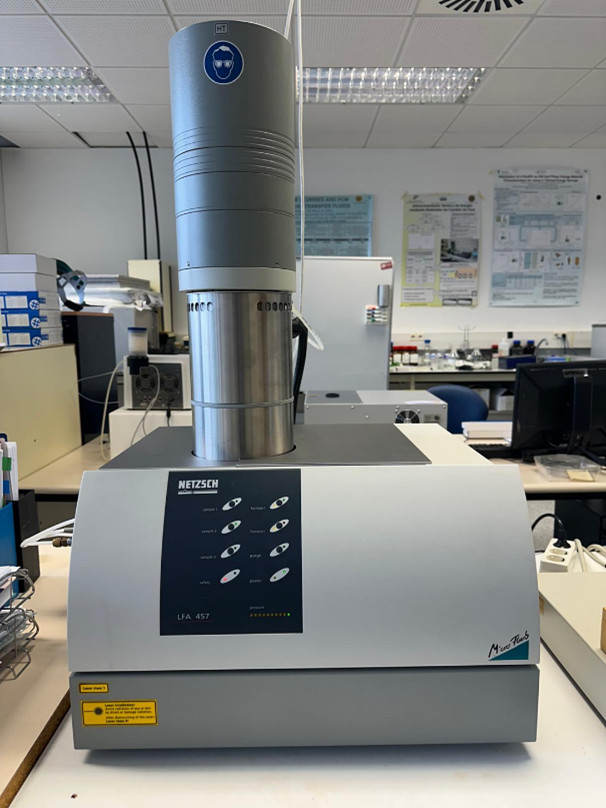
Model: LFA 456, Netzsch
Properties: Thermal diffusivity / thermal conductivity
Temperature range: Ambient/1100°C
Samples: solid / liquid / powder
Sample size: Solid: Ø 12.6 mm × Ø 25.4 mm × thickness (0.5–5 mm) (thickness to be determined based on the sample’s estimated thermal diffusivity) Liquid: 0.01 ml
Contact:
- Mónica Delgado: monica@unizar.es
Transient hot wire
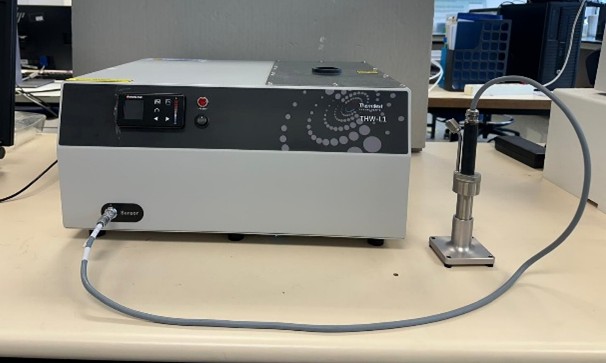
Model: THW-L1, Thermtest
Properties: Thermal conductivity
Temperature range: 20-200ºC
Thermal conductivity range: 0,01-2 W/m/K
Samples: Liquid
Sample size: 20 ml
Contact:
- Mónica Delgado: monica@unizar.es
Thermomechanical analyser
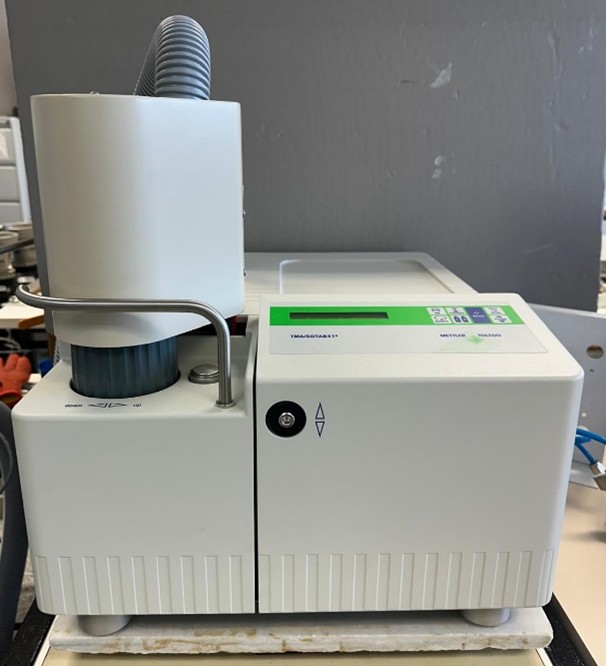
Model: TMA 841e, Mettler Toledo
Properties: Density, coefficient of linear thermal expansion
Temperature range: -150ºC/600ºC
Samples: solid / liquid
Sample size: Solid: approx. Ø 6 mm × 6 mm, maximum thickness 2 mm Liquid: 0.01 ml
Contact:
- Mónica Delgado: monica@unizar.es
Density meter (oscillating U-tube)
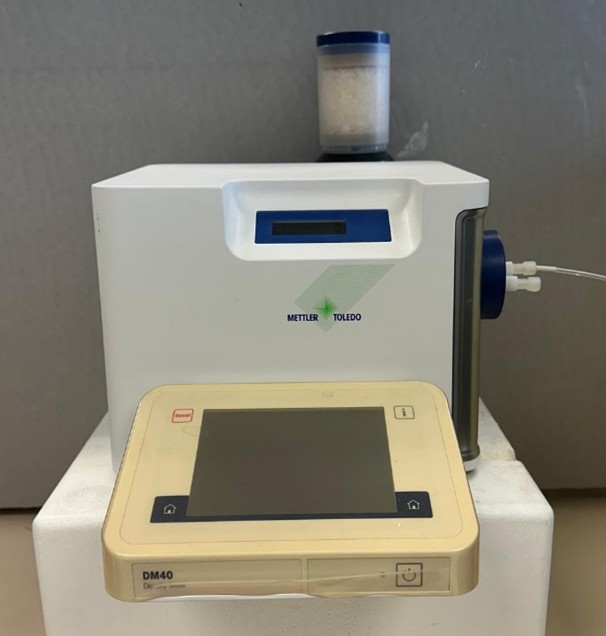
Model: DM40, Mettler Toledo
Properties: Densidad
Temperature range: Ambiente-90ºC
Range of densities: 0-3 g/cm3
Samples: líquido
Sample size: 1 ml
Contact:
- Mónica Delgado: monica@unizar.es
Controlled stress rheometer
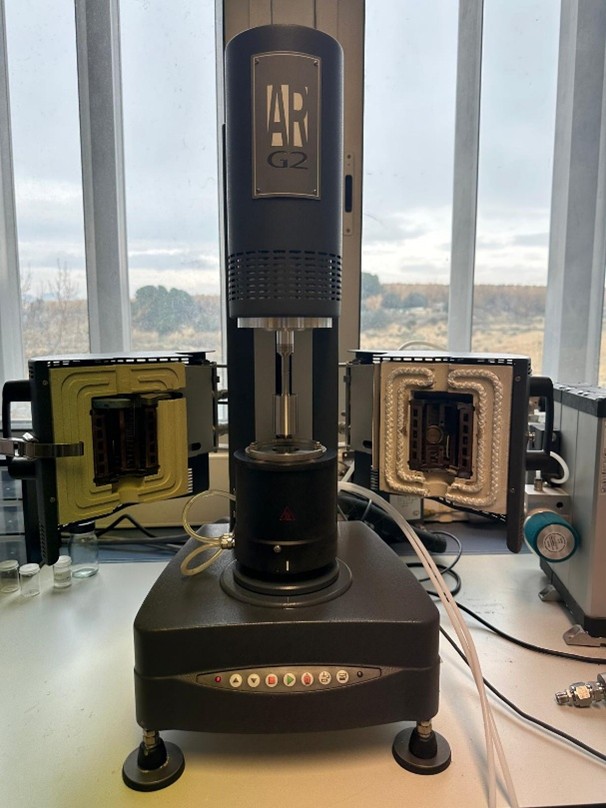
Model: AR-G2, TA Instruments
Properties: Viscosidad (rotacional/oscilatorio)
Temperature range: -150ºC / 600ºC
Geometries: plato, cono, cilindros concéntricos
Samples: líquido
Sample size: 0,5-30 ml
Contact:
- Mónica Delgado: monica@unizar.es
GC-MS analyser with NCD detection
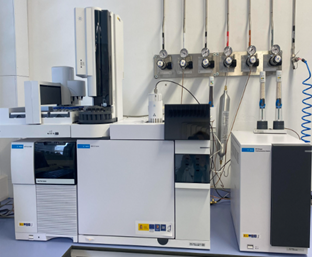
Model: 5877C GC/MS - 8255 NCD Agilent
Properties: The system enables the separation, identification and quantification of complex organic mixtures using dual-detection technology.
- Module (MS): It determines the structure of unknown compounds by comparing their mass spectra (molecular fingerprints) with international reference libraries (NIST).
- Nitrogen Chemiluminescence Detector (NCD): It offers high sensitivity and selectivity for the quantification of nitrogen-containing compounds.
Samples: Liquid
Sample size: 1-10 ml
Contact:
- Olga Marín: olganar@unizar.es
Mercury porosimeter
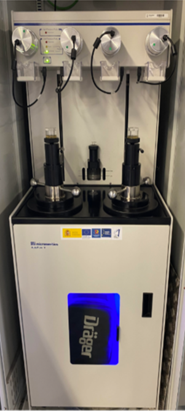
Model: Autopore V 1086 Micromeritics
Properties: Allows the characterization of the porous structure of solid materials through the technique of mercury intrusion and extrusion at controlled pressures. This method enables the calculation of the volumes of macropores and mesoporos, as well as the precise determination of the pore size distribution.
Analysis Ranges:
| Analysis | Pressure Range | Pore Diameter Range (Ø) |
|---|---|---|
| Low Pressure | 0.2 a 50 psia | 500 a 3.6 μm |
| High Pressure | Atmosphere to 60,000 psia | 6 a 0.003 μm (3 nm) |
Samples: solid / powder
Sample size: 200 mg
Contact:
- Olga Marín: olganar@unizar.es
Intuvo GC/MS-FID analyser
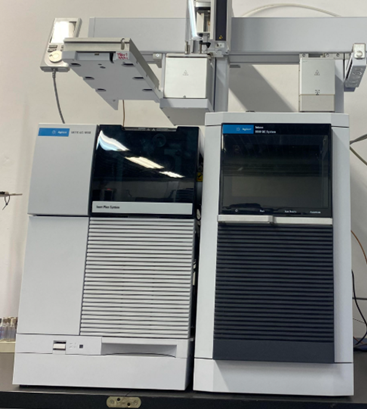
Model: 5977C GC/MS- 9000 GC Agilent
Properties: The system allows the separation, identification and quantification of complex organic mixtures through dual detection technology.
- MModule (MS): Determines the structure of unknown compounds by comparing their mass spectra (molecular fingerprint) with international reference libraries (Nist).
- Module (FID): Provides an exact and highly sensitive measurement of the amount of each component present, being the standard detector for the analysis of hydrocarbons and organic compounds.
Samples: liquids
Sample size: 1-10 ml
Contact:
- Olga Marín: olganar@unizar.es