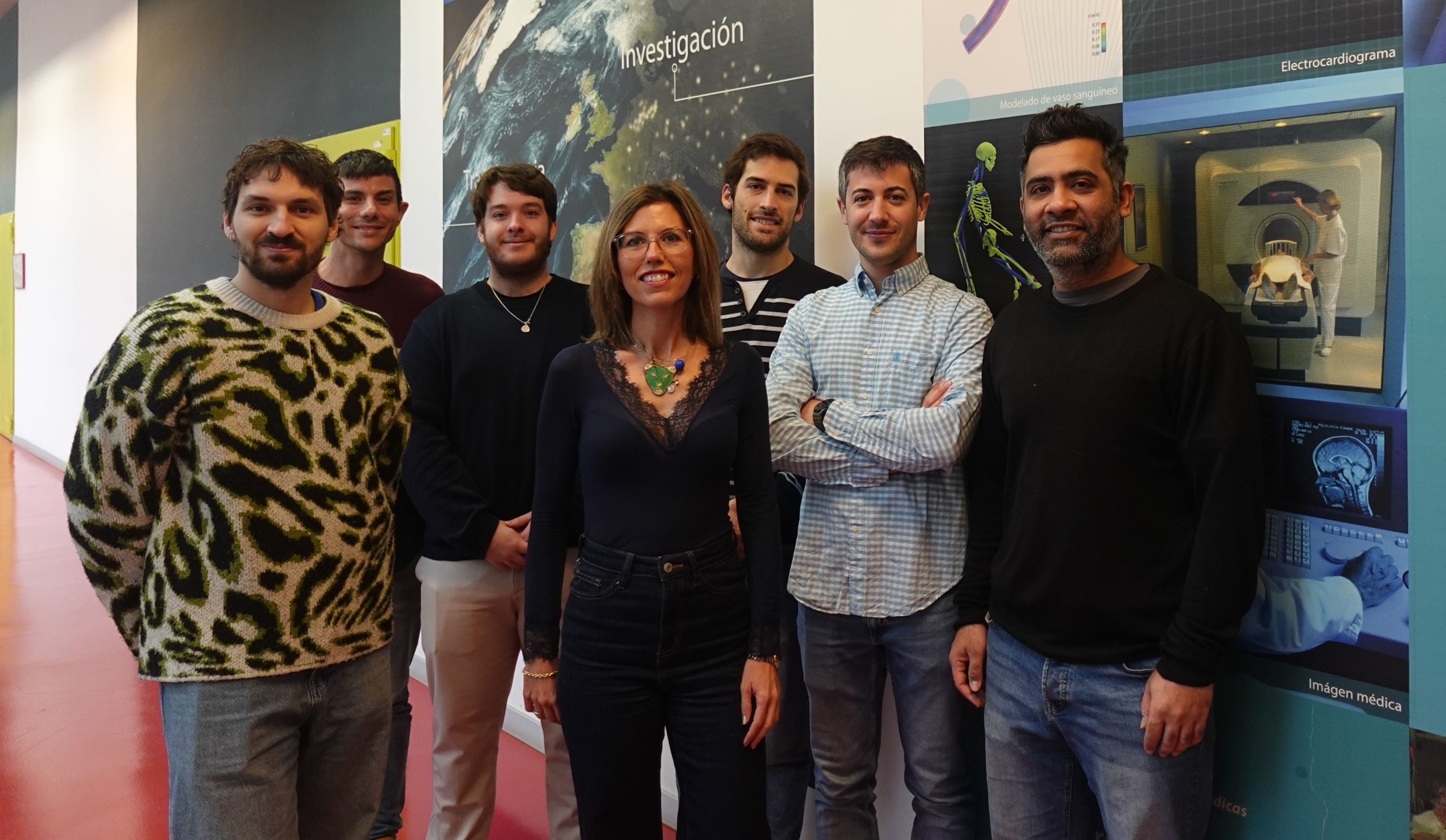
A team of seven researchers from the BSICoS (Biomedical Signal Interpretation and Computational Simulation) group at the Aragón Engineering Research Institute (I3A) of the University of Zaragoza has won the Second Multimodal Sensing Grand Challenge for Next-Gen Pain Assessment (AI4PAIN 2025), an international challenge held in Australia as part of the ACM International Conference on Multimodal Interaction. Among groups from many countries, the Aragonese group demonstrated new ways of measuring pain more objectively through artificial intelligence.
The model created stands out for its measurable approach, a single biomarker that measures pain, combining artificial intelligence with different markers developed by the BSICoS group in previous years. As they explain, ‘this biomarker offers a value that, clinically, gives pain an objective character, something especially important in people with communication difficulties.’ In addition, they point out that each person has their own pain threshold and that the manifestation of pain has cultural differences, which reinforces the need to develop objective and inclusive tools that allow for better interpretation of physiological responses to pain.
Using a hybrid method that combines deep learning and traditional machine learning with physiology-guided signal processing, the research team trained a neural network to detect patterns and applied explanatory machine learning techniques to select the most optimal combination of biomarkers for pain detection. ‘Our model not only achieved high accuracy (F1 = 0.84 in validation), but also demonstrated that it is possible to identify objective markers of pain through modulations in the cardiovascular system and micro-sweating caused by the autonomic nervous system,’ they explain.
The purpose of this research is to advance towards the creation of objective pain biomarkers, a challenge that remains unresolved in the scientific and medical fields. ‘Measuring pain accurately would allow treatments to be adjusted, diagnoses to be improved, and more accurate and personalised follow-up to be offered,’ they explain.
The AI4PAIN 2025 Challenge has held its second edition, focusing on physiological signals. The first, in 2024, was based on the analysis of facial expressions using video. Both challenges are part of an international line of research that seeks to bring together researchers from different disciplines to improve the understanding of human pain.
This work has been published in the Companion Proceedings of the 27th International Conference on Multimodal Interaction of the Association for Computing Machinery. (link to the article), entitled: ‘Explaining Pain by Combining Deep Learning Models and Physiology-Driven Ensembles using PPG, EDA, and Respiration’, by Miguel Javierre, Pablo Armañac, Rodrigo Lozano, Diego Cajal, Nayan Wadhwani, Jesús Lázaro, and Raquel Bailón.