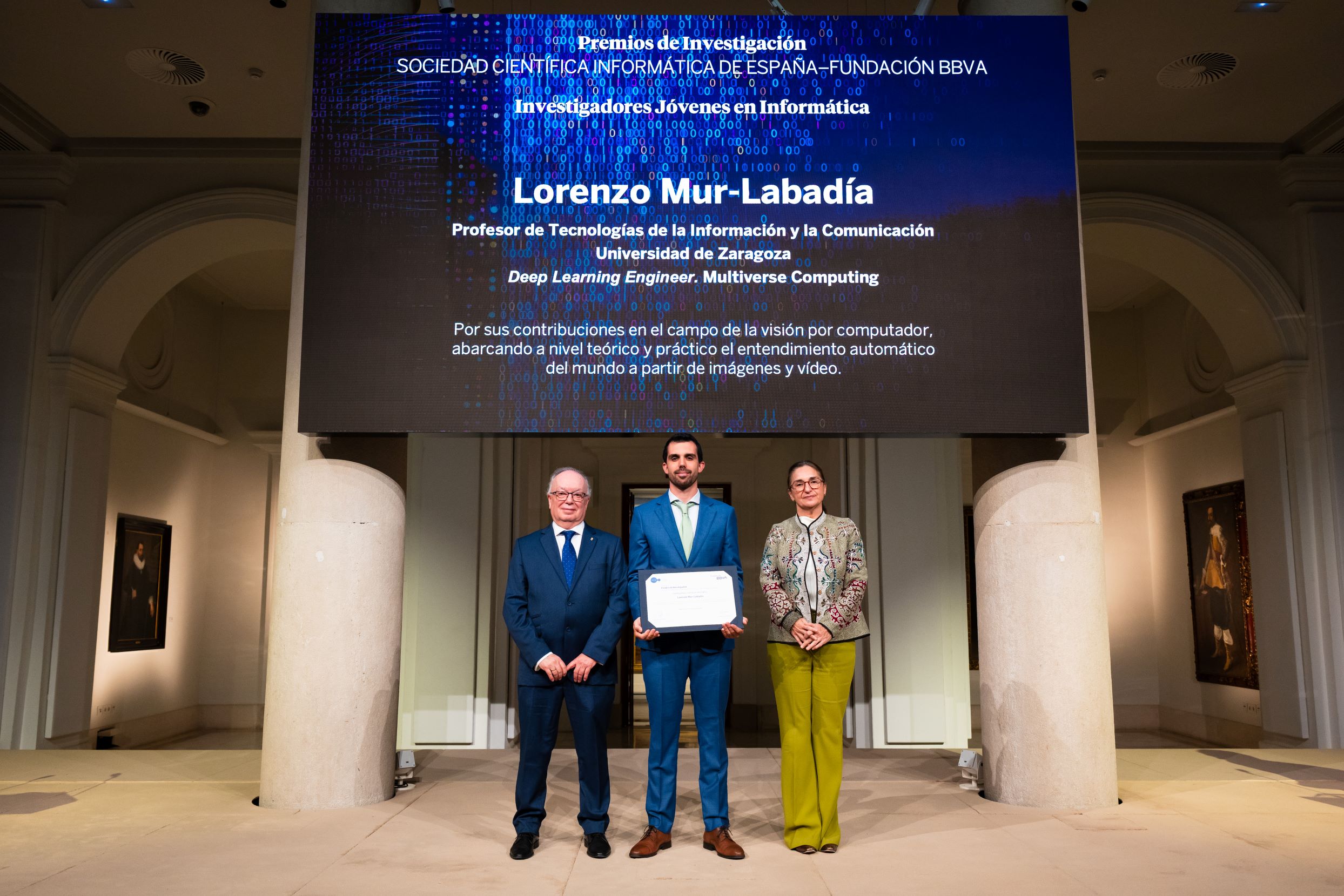
Lorenzo Mur-Labadía has just been awarded the Spanish Computer Science Society–BBVA Foundation Research Prize in the ‘Young Researchers in Computer Science’ category. This recognition is in honour of his contributions to the field of computer vision, both at a theoretical and applied level, addressing one of the fundamental problems: the automatic understanding of the world through images and video.
Lorenzo Mur holds a PhD in Computer Science from the University of Zaragoza and is a locum lecturer in Information and Communication Technologies, a Deep Learning Engineer at the start-up Multiverse Computing, and a researcher in the Robotics, Computer Vision and Artificial Intelligence group at the Aragon Engineering Research Institute (I3A). His work has enabled him to establish himself as a leading researcher, with an exceptional combination of scientific rigour, independence and international standing.
His research focuses on developing artificial intelligence models capable of understanding video footage. “We train the AI to understand which objects appear in a scene, what actions are taking place, and what is going to happen next,” he explains. Mur-Labadía envisages that his work in the field of computer vision could have a wide range of applications of great interest to society, from a self-driving car capable of anticipating when an accident is about to happen to the development of smart glasses that can understand what we see to help us in new situations or detect potential risks.
These smart glasses could also prove extremely useful for people with vision or memory problems. “Imagine if an elderly person could wear a pair of glasses that monitored how they went about their day and were able to remind them, for example, of the last place they left their keys or whether they’d taken the right medication,” he points out, highlighting this as one of the key aspects of his work.
“Artificial intelligence is the Pandora’s box of our time,
an increasingly fast-paced world where change is the only constant”
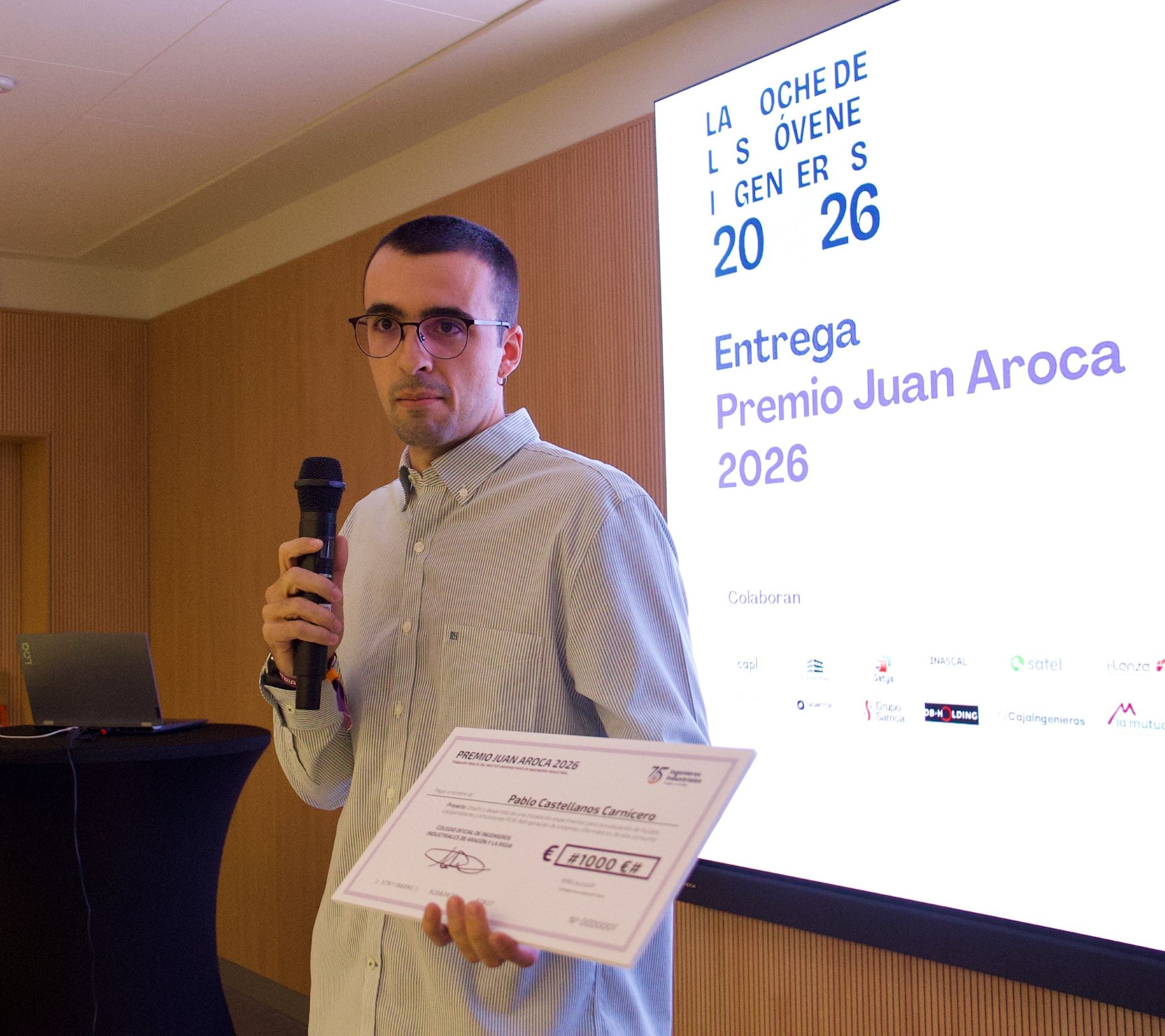
Lorenzo Mur began his speech with these words at the awards ceremony held in Madrid on 5 November. In his address, he asked whether “we will reach a future of abundance, where the surge in productivity will allow us to work fewer hours, or, on the contrary, whether the labour market will collapse when white-collar workers begin to be replaced by increasingly autonomous language models”.
He paid tribute to the generations of “our grandparents across Europe who shouldered the burden of a continent devastated by world wars and civil wars; today, we young people want to lead this new revolution to achieve a more prosperous, free and safe society for all”.
I would therefore like to begin by thanking the BBVA Foundation and the Spanish Scientific Society of Computer Science for this recognition, and even more so for raising the profile of young talent in our country. We, the young people, want to lead this revolution and set an example that inspires others.
Over the past five years, the focus of his research has been on teaching machines to see and understand the world as humans do. In his final year of his PhD, he had the opportunity to work in one of the world’s most advanced laboratories, under the leadership of Yann LeCun, one of the pioneers of artificial intelligence and a Turing Award winner. He led the development of the next generation of Video-JEPA, one of the most powerful so-called ‘world models’ to date. Inspired by how babies learn, the model watches millions and millions of videos without any description whatsoever. Completely autonomously, it manages to extract information, identify objects, anticipate what will happen next and even show surprise if an object suddenly changes shape.
His speech included words of thanks to the Spanish Computer Science Society and the BBVA Foundation, to his thesis supervisors, Josechu Guerrero and Rubén Martínez Cantín, and to his family and friends.
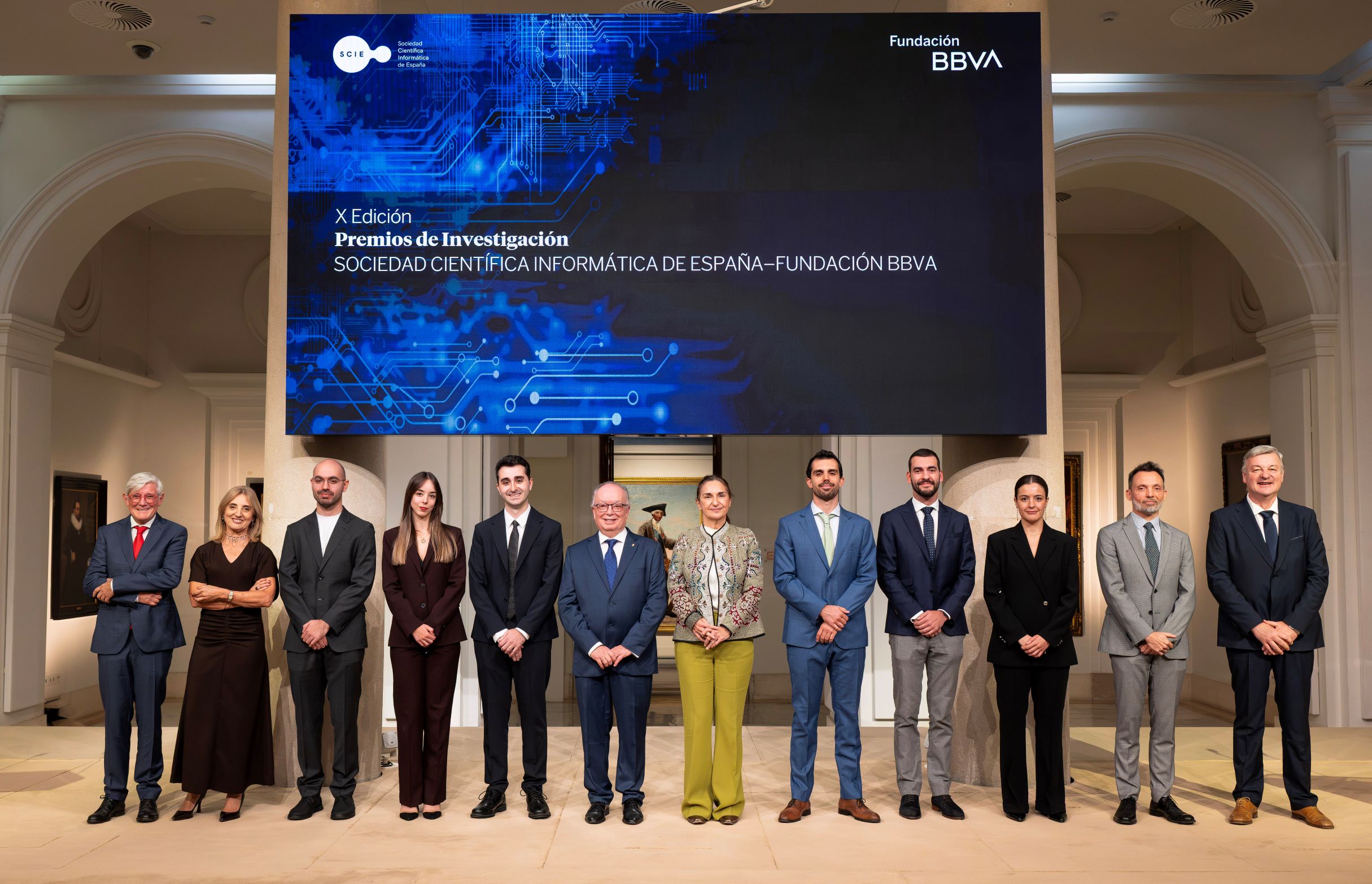
The 2026 Computer Science Awards have celebrated the cross-cutting value of technology as a tool for empowerment at the service of society. The 10th edition of these awards has recognised the excellence of six young scientists, the careers of three senior researchers and the work of a company whose contributions are already being applied in a wide range of fields, such as artificial intelligence, robotics, virtual reality, biometrics and the development of devices for the care of the elderly or those in need of care.
Information on Lorenzo Mur-Labadía’s contribution:
https://www.fbbva.es/noticias/fallados-premios-informatica-scie-fundacion-bbva-2026/
Information on the awards:
https://www.fbbva.es/premios/premios-investigacion-sociedad-cientifica-informatica-espana-fundacion-bbva-2026/
Fotografías: Fundación BBVA